Disagreement
Disagreement
Graham's Hierarchy of Disagreement
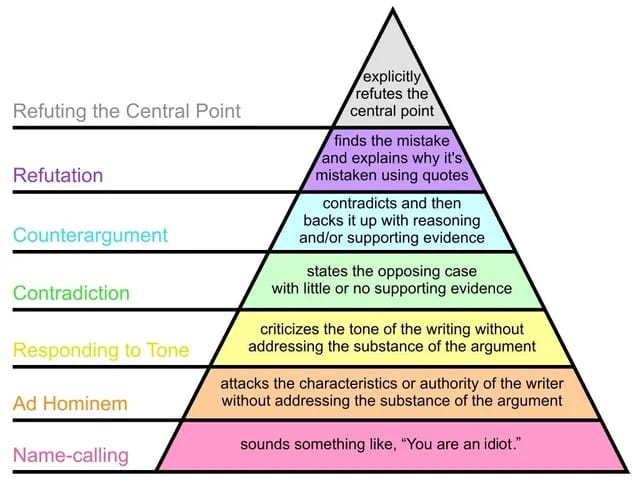
From bottom (worst) to top (best):
| Level | Method | Example |
|---|---|---|
| Name-calling | Ad hominem insult | "You're an idiot" |
| Ad hominem | Attack the person, not the argument | "You only say that because you're young" |
| Tone policing | Dismiss based on how it's said | "You sound angry, so you must be wrong" |
| Contradiction | State the opposite without evidence | "No, that's wrong" |
| Counterargument | Present opposing reasoning | "But consider X because Y..." |
| Refutation | Quote and dismantle specific claims | "You said X, but the evidence shows Y" |
| Refuting the central point | Address the core thesis directly | "Your entire premise fails because..." |
Why This Matters
Most online (and offline) disagreement operates at levels 1-4. Levels 5-7 require actually understanding what the other person said — which most people skip because it's harder than reacting emotionally.
Practical filter: If someone responds to your argument with name-calling or tone policing, they're telling you they can't engage with your actual point. Disengage — there's no productive path forward.
My Take
I naturally operate at levels 5-6 and it makes me "speak rough." Most people experience refutation as aggression because they've never had their central point challenged directly. The skill isn't softening the disagreement — it's reading whether the other person can handle productive conflict at all.